Sendzimir and Cluster Mills have operating conditions significantly different from conventional Cold Strip
Mills (CSM). They use small-diameter work rolls supported by multiple
intermediate and backing elements, which generate very high specific pressure in
the strip contact zone. For this reason, these mills are used for stainless
steels, silicon steels, and other hard-to-roll materials.
Under such conditions, conventional
forged roll materials such as Cr-Mo or Cr-Ni-Mo grades cannot provide sufficient
wear resistance, surface stability, and load-bearing support. Therefore,
higher-alloy materials are selected according to actual rolling
conditions, rolled product surface requirements, contact pressure, and the
required balance between wear resistance and toughness.
Roll naming varies with mill
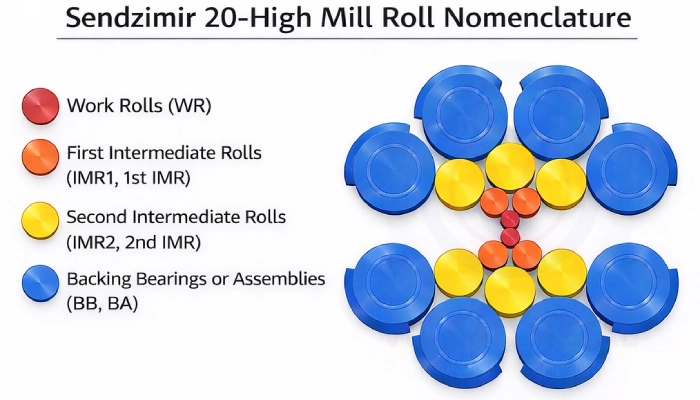
layout. In 20-High Sendzimir Mills, the roll stack is generally described by
work rolls, first intermediate rolls, second intermediate rolls, and backing
bearings (backing assemblies). In some layouts, driven and idler positions
appear within the intermediate-roll set. In Z-High Mills and other Cluster
Mills, work rolls are supported by intermediate rolls together with
side-support or backing rolls. Each roll type has a different function in the roll
system:
The material groups described here are used mainly for work and intermediate rolls. Backup rolls, side-support rolls, and
backing assemblies are typically based on Cr-Mo or Cr-Ni-Mo forged grades.
These materials do not form a fixed grade
structure. In Sendzimir and Cluster
Mills, material selection is application-driven. Selection of high-chromium tool steels, medium-high alloy tool steels, and Semi-HSS and HSS grades depend on rolling conditions, roll diameter, contact pressure, and the
required balance between wear resistance and toughness.
High-Chromium Tool Steels are the primary material group for Sendzimir and Cluster Mill Rolls where maximum
wear resistance and high surface stability are required under very high contact
pressure. They are mainly used for work rolls and, in selected cases, for
intermediate rolls where wear resistance is more important than
toughness.
These materials are
characterized by high carbon and chromium content, resulting in a high carbide volume.
They provide very strong wear resistance and surface stability, however, they exhibit lower toughness and higher sensitivity to cracking, grinding damage, and
instability. Their effective working
layer is relatively limited, but wear resistance within that layer remains very
high.
Typical materials include Cr12, Cr12MoV, Cr12MoVCo, Cr12Mo1V1 (D2, 1.2379), and related 12%Cr high-chromium cold-work
tool steels.
Medium-High Alloy Tool Steels are used where high-chromium tool steels remain too brittle and
conventional forged grades are not sufficient. They are used mainly for
selected work rolls and intermediate rolls, requiring a more balanced combination of
wear resistance and toughness.
Compared with high-chromium tool steels, they provide higher toughness and instability tolerance. They are used where rolling conditions require a more balanced material response.
Typical materials include 5Cr5WMoVSi, 9Cr2Mo, X63CrMoV5-1 (1.2362), 5H12 (H12), selected 8%Cr grades, and related medium-high
alloy roll steels.
Semi-HSS and HSS Rolls are used in selected cases, where a deeper effective
working layer with high wear resistance is required. In Sendzimir and Cluster Mills, these materials become more sensitive to rolling stability, cooling consistency, and grinding practice due to smaller
roll diameters and much higher localized stress.
They are not typical
materials for backup rolls, side-support rolls, or backing bearings (backing assemblies).
Material
selection in Sendzimir and Cluster Mills is based on roll function. It depends on
contact pressure, roll geometry, rolled product surface requirements, and the
required balance between wear resistance and toughness.
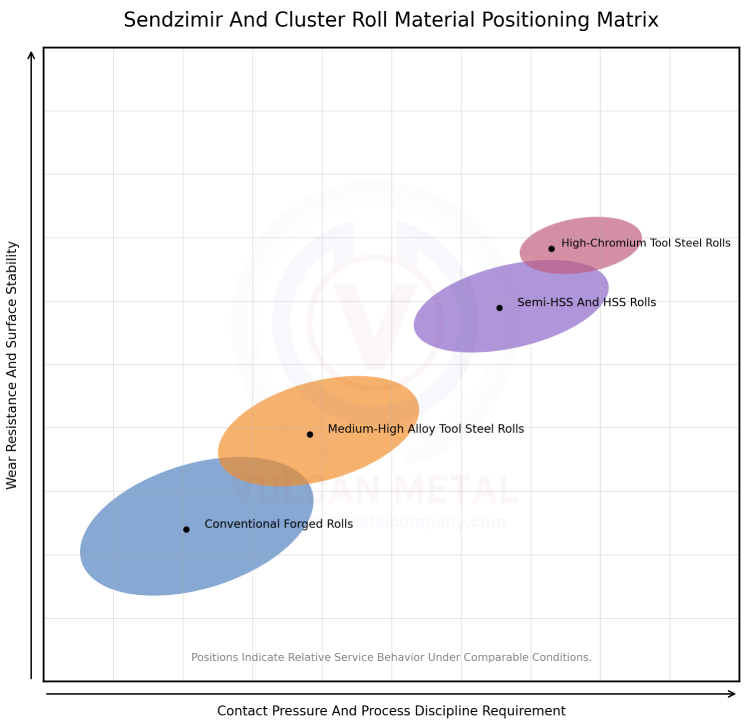
This is not a linear upgrade path or a simple
increase in alloy content. High-chromium tool
steels are selected where maximum wear resistance and surface stability are
required. Medium-high alloy tool steels are preferred where improved toughness and
higher instability tolerance are needed. Semi-HSS and HSS rolls are used in
selected cases where a deeper effective working layer is required.
Sendzimir and Cluster Forged Rolls belong to the broader family of forged rolling mill rolls used in steel and non-ferrous rolling mills.
Vulcan Metal provides forged rolling mill rolls, including Sendzimir and Cluster Forged Work Rolls, Intermediate Rolls, Idler or Driven Rolls and other forged roll materials, selected according to actual rolling mill conditions and performance requirements.
For additional information, you can also consult our page on
Forged Rolling Mill Rolls.
In addition, you may refer to our dedicated pages covering the main forged roll material families: