Semi-HSS
and HSS Forged Work Rolls (Semi-HSS WR, HSS WR) are used where Cr-Ni-Mo Forged Work Rolls can no longer maintain sufficient
wear resistance and effective working layer through campaigns, and where the
rolling conditions justify transition to a higher-alloy forged work roll
family.
They are mainly used in cold strip mills, tandem mills, reversing mills,
double-reduction mills, temper mills, and skin pass mills. Their use in hot
strip mill work roll positions is limited. In
these mills, rolled product surface quality, controlled wear, and surface
stability directly influence campaign length. The objective is not simply to
increase hardness, but to improve wear resistance and strengthen effective
working layer.
Grade selection must not be
determined by mill or stand type alone. It should be based on rolling mill
parameters and performance targets, including rolled product surface quality,
wear behavior, campaign length, rolling stability, thermal conditions, cooling consistency, and grinding practice. Semi-HSS and HSS Forged Work Rolls have lower instability tolerance and require tighter control of rolling and roll shop conditions.
Semi-HSS and
HSS Forged Work Rolls belong to the same high-alloy forged work roll
family. Their difference lies in how effective working layer, wear resistance,
surface stability, and instability tolerance are balanced according to actual
rolling mill conditions.
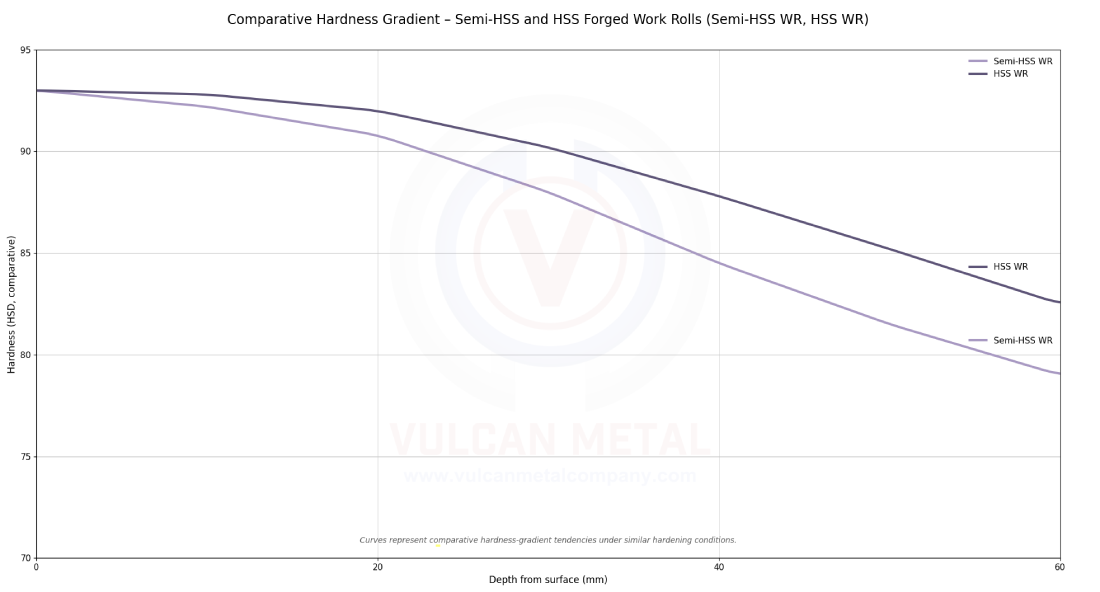
Semi-HSS and HSS Forged Work Rolls form a
high-alloy forged work roll group in which wear resistance, effective working
layer, and surface stability are increased beyond Cr-Ni-Mo Forged Work Rolls. The
difference between Semi-HSS and HSS lies in how these properties are achieved.
Higher alloy content and
stronger carbide support may improve wear resistance, roughness retention, and
usable service life, but only when supported by mill stability, heat treatment
quality, cooling consistency, and grinding practice. Increased alloy content
reduces instability tolerance and increases sensitivity to less controlled
operating conditions. The most highly alloyed grade is not always the correct
solution. Grade selection must be based on actual rolling conditions, rolled
product quality targets, campaign length, and roll shop capability.
Common
failure mechanisms include grinding-induced cracking, carbide-related crack
initiation, and spalling under combined mechanical and thermal stresses.
Premature loss of usable service life may occur under unstable cooling or
inadequate grinding practice. This is not a universal upgrade, but a
controlled transition, requiring tighter rolling and roll shop controls.
Semi-HSS
and HSS Forged Work Rolls (Semi-HSS WR, HSS WR) belong to the broader family of forged rolling mill rolls used in steel and non-ferrous rolling mills.
Vulcan Metal provides forged rolling mill rolls, including Semi-HSS and HSS Forged Work Rolls and other forged roll materials, selected according to actual rolling mill conditions and performance requirements.
For additional information, you can also consult our page on
Forged Rolling Mill Rolls.
In addition, you may refer to our dedicated pages covering the main forged roll material families: