Cr-Ni-Mo Forged Work Rolls (CrNiMo WR) are used where
standard Cr-Mo Forged Work Rolls can no longer maintain sufficient wear
resistance and hardness through campaigns, but where transition to Semi-HSS or
HSS is not yet justified in terms of rolling conditions or cost.
They
are mainly used in cold strip mills, tandem mills, skin pass mills, and similar
flat-product mills. Their use in hot strip mills is limited. Since maintaining
surface integrity through campaigns becomes critical in these mills, the higher
instability tolerance of standard Cr-Mo grades becomes less influential in
material selection.
This
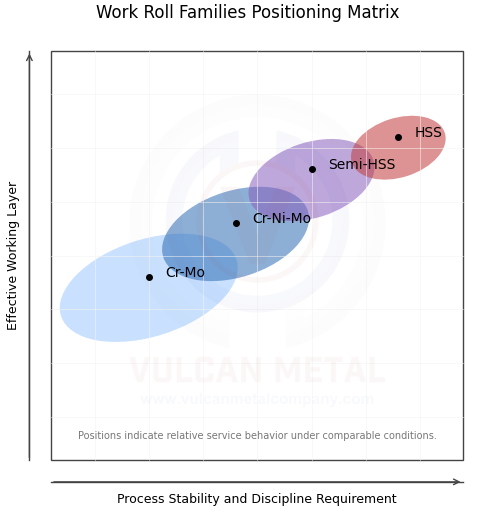
means a controlled transition. The objective is to increase the effective working
layer and maintain stable performance through campaigns. Compared with standard
Cr-Mo grades, Cr-Ni-Mo Rolls have lower tolerance to instability, variations in
grinding practice, and cooling inconsistency. However, they are more tolerant
than Semi-HSS and HSS which require tighter rolling and roll-shop control.
Cr-Ni-Mo Forged Work Rolls are not defined
by a fixed grade structure. In
practice, they are produced from Cr-Ni-Mo alloy steels tailored for roll
production under specifications controlled by the roll-maker. Common references include steels such as 34CrNiMo6, 30CrNiMo8, 40CrNiMo or 40CrNiMoA, 70CrNiMo, as well as broader designations such as 50-70CrNiMo. These references indicate the material type, but they do not
define roll performance.
Grade
selection must be based on actual rolling conditions and performance targets,
rather than material reference alone.
Cr-Ni-Mo Forged Work Rolls represent a working
range rather than a fixed grade structure, in which a deeper effective working
layer with stronger wear resistance is achieved while maintaining toughness
under actual rolling conditions.
Compared with standard Cr-Mo WR grades, they
extend the effective working layer and support more stable campaign performance
under controlled rolling conditions. They are more tolerant than Semi-HSS, but
less forgiving than standard Cr-Mo WRs. Cr-Ni-Mo Work Rolls are not suitable for
mills with unstable rolling conditions, poor cooling control, or inconsistent
grinding practice.
Common failure mechanisms include grinding-induced
cracking, surface damage under unstable rolling conditions, and premature loss
of usable service life. They typically result from operating conditions that do not adequately support
the material response.
Cr-Ni-Mo Forged Work Rolls (CrNiMo WR) belong to the broader family of forged rolling mill rolls used in steel and non-ferrous rolling mills.
Vulcan Metal provides forged rolling mill rolls, including Cr-Ni-Mo Forged Work Rolls and other forged roll materials, selected according to actual rolling mill conditions and performance requirements.
For additional information, you can also consult our page on
Forged Rolling Mill Rolls.
In addition, you may refer to our dedicated pages covering the main forged roll material families: